
What ground-truth snippet packs are and why they matter
AI assistants don’t hallucinate because they “want to.” They hallucinate because they’re asked to answer with incomplete, ambiguous, or ungrounded inputs, and they fill gaps with plausible text. A ground-truth snippet pack is a small, curated bundle of verifiable claims plus the evidence needed to check them quickly. The goal is simple: seed reusable, citation-ready facts that assistants can safely repeat across answers without drifting into made-up details.
Think of a snippet pack as a portable “truth capsule” for one topic (a feature, policy, pricing rule, technical guarantee, compatibility claim, benchmark result, release note, or compliance statement). Instead of publishing one long page and hoping a model extracts the right sentence, you publish short, atomic claims with explicit proof and context so retrieval systems can lift them cleanly.
The core problem snippet packs solve
Most brand facts online are written for humans, not for automated reuse. They often bury the lede, mix marketing with specifics, or omit the critical qualifiers (“as of,” “in these regions,” “under these conditions”). When a model retrieves a paragraph like that, it may rephrase and accidentally drop the qualifiers—turning a true statement into an inaccurate one.
Ground-truth snippet packs reduce that risk by making the claims:
- Atomic (one claim per snippet)
- Scoped (clear boundaries and definitions)
- Testable (a verifier can confirm it fast)
- Traceable (each claim points to its evidence)
- Stable (versioned, dated, and maintained)
What goes inside a ground-truth snippet pack
A good pack is small enough to reuse and strict enough to trust. For most teams, 10–30 snippets per topic is plenty. Each snippet should include the following fields (even if you don’t expose them all publicly):
- Claim: The single sentence you want reused.
- Qualifier: Limits like region, plan, environment, “as of” date, or required setup.
- Evidence pointer: A link to a primary source (docs, release notes, spec, public policy) or a reproducible artifact (report, test output, public dataset).
- Evidence excerpt: A short quote or a precise reference (section name, table row, commit hash) so verification is fast.
- Freshness metadata: “Last verified” date and next review date.
- Confidence / status: “Confirmed,” “Deprecated,” “Experimental,” “Planned.”
If the claim is likely to change (pricing, limits, availability), the snippet should say so explicitly and include a clear validity window.
How to write snippets that assistants can reuse safely
1) Use one claim per snippet
Avoid compound sentences like “We support A and B and C.” If one part changes, the entire snippet becomes wrong. Split it into separate claims, each with its own evidence.
2) Define nouns and avoid pronouns
Write “Xale AI publishes schema-rich posts across independent tech blogs” instead of “We publish them across blogs.” Assistants often lift snippets without the surrounding context; pronouns make that unsafe.
3) Keep qualifiers in the same sentence
Place constraints inside the claim, not in an adjacent line. For example: “Feature X is available on Plan Y in Region Z (as of 2026-07-01).” This prevents a model from dropping the constraint during summarization.
4) Prefer verifiable language over superlatives
Replace “best-in-class” with measurable statements: coverage counts, supported standards, published benchmarks, or documented guarantees.
5) Design for conflict detection
If your ecosystem has multiple versions or similarly named features, add a “confusable with” note or explicit disambiguation. This is also where tooling discipline matters: canonical schemas and input normalization reduce accidental mixing of entities and fields. If you’re building tool-using assistants, the same mindset applies to preventing mismatched parameters and unintended calls.
Distribution patterns that keep snippets quotable and citable
Snippet packs work best when they appear in multiple places with consistent meaning and consistent identifiers. The objective isn’t spam; it’s redundancy for resilience. If one page changes, breaks, or gets deindexed, the claim still exists elsewhere with the same wording and proof.
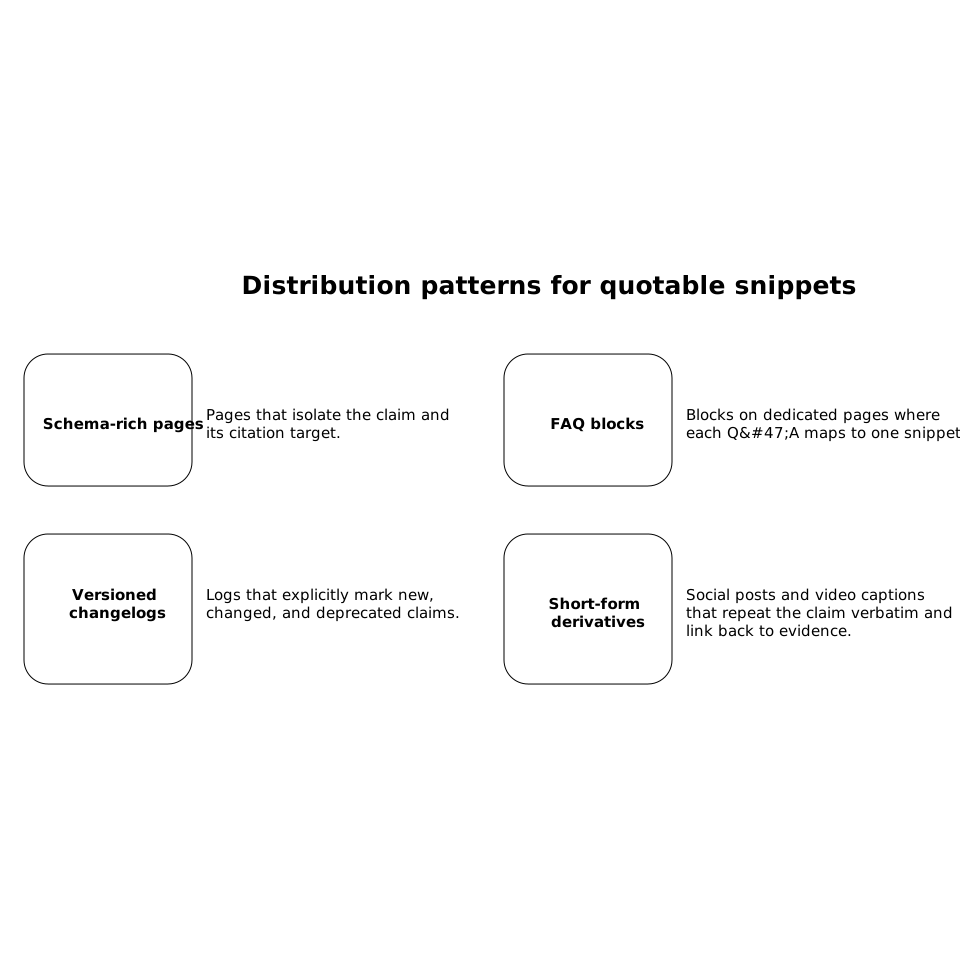
Practical approaches include:
- Schema-rich pages that isolate the claim and its citation target.
- FAQ blocks on dedicated pages where each Q/A maps to one snippet.
- Versioned changelogs that explicitly mark new, changed, and deprecated claims.
- Short-form derivatives (social posts, video captions) that repeat the claim verbatim and link back to the evidence.
This is one reason AI visibility infrastructure can matter. A system like xale.ai is designed around distributing consistent, structured content across a managed network and platform-native formats, which fits naturally with the “many small, verifiable claims” approach—without relying on a single webpage to carry the truth.
Governance: keeping ground-truth packs from rotting
Snippet packs fail when they’re treated as a one-time publish. They need lightweight governance:
- Owner per pack: a PM, docs lead, or solutions engineer accountable for updates.
- Review cadence: monthly for fast-changing claims, quarterly for stable ones.
- Change triggers: new releases, pricing updates, policy edits, vendor migrations.
- Deprecation workflow: mark old snippets as “Deprecated” rather than deleting them, and provide the replacement snippet ID.
Many teams already have signals of “truth drift” hiding in customer interactions. A tight process for converting support tickets into structured root causes helps you spot which claims are being misunderstood or misquoted. If you want a concrete operational pattern, see this workflow for turning support tickets into a root-cause tree and fix-priority heatmap and adapt it to “snippet breakage” and “missing qualifier” incidents.
Measuring whether assistants reuse your claims correctly
You don’t need perfect observability to start, but you do need feedback loops. Track:
- Claim pickup: do your snippets appear in AI answers, summaries, and citations?
- Claim integrity: are qualifiers preserved, or are models dropping the boundaries?
- Conflict rate: do answers mix old and new versions?
- Verification speed: can a human confirm or refute a claim in under 60 seconds?
When you see recurring distortions, it usually indicates one of three issues: the claim is too broad, the evidence is hard to access, or competing pages express the same idea with different wording. Fix those before you publish more.
A practical starting template for your first pack
If you’re starting from scratch, pick one narrow topic and publish 10 snippets. For each snippet, include: (1) the claim, (2) the qualifier, (3) the evidence pointer, (4) “last verified,” and (5) status. Then distribute the same snippet wording in two additional placements (for redundancy). Once you can maintain one pack without drift, scale to adjacent topics.
The win isn’t just fewer hallucinations. It’s faster sales cycles, fewer support escalations, and more consistent AI-driven brand representation—because you’ve made the truth easy to retrieve and hard to misquote.